Gene Smith
Pat & I felt truly blessed to be able to call Gene a wonderful friend with a noble heart. He accomplished something that few could say was to make a major contribution toward making the world a better place.
I got to know Gene when he returned to the Library of Congress on home leave. He was a consummate librarian and administrator. Living in India, in 1968 he joined the Library of Congress’s New Delhi Field Office as a young scholar and, in addition to his administrative duties, developed a program to reprint Tibetan Buddhist texts. Many Tibetan books were destroyed during the Chinese Cultural Revolution in the 1960s when monasteries and libraries were burned and some books were lost while the Tibetans were fleeing their county. For the next three decades, including his work after he left the Library of Congress, he tirelessly led the effort to locate and reprint every extant Tibetan text. In doing, he rescued numerous Tibetan Buddhist traditions from extinction.
He had studied Tibetan studies at the University of Washington and was fluent in the Tibetan language and Sanskrit, among others. He was a convert from Mormonism to Buddhism. He served the Library of Congress by also heading my offices in Indonesia and Egypt.
Because of his help to the National Library of Bhutan in preserving its collections, he became friends with Bhutan’s Queen Mother and, through this contact, was able to arrange for Pat and me, representing the Library of Congress, to be her guests for a five-day trip to Bhutan. (See Trips – 1982 – Bhutan)
Gene had founded and became the head of the Tibetan Buddhist Resource Center (TBRC) in New York City.
Representatives of more than 300 Tibetan Buddhist monasteries in Tibet, India, Nepal and Bhutan unanimously nominated Gene for a lifetime achievement award for his contributions to the preservations of the Tibetan literary and spiritual heritage. The award ceremony took place at the Nyingma Monlam Chenmo International Prayer Festival in Bodhgava, Bihar, India, January 22-23, 2010.
When ancient writings of Sanskrit and Tibetan texts vanish during the political turmoil of the 1950s and 1960s, the history of a whole society-–its beliefs, customs and sense of enlightenment were in danger of disappearing. Gene became the leader of an effort to rescue, preserve and share. Digital Dharma: One Man’s Mission to Save a Culture is a 2012 American documentary film directed by Dafna Yachin. The film depicts the 50-year journey by Gene to hunt down and digitize over 20,000 missing volumes of ancient Tibetan text.Gene with unknown Buddhist monkGene with unknown Buddhist monkGene with unknown Buddhist monkGene with unknown Buddhist monk In 1999.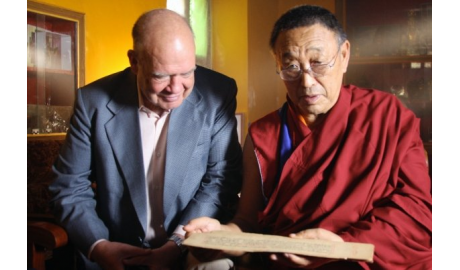
Gene, with friends, founded the Tibetan Buddhist Resource Center (TBRC) in New York City (with a grant from the Soros Foundation), to digitize the 12,000 volume corpus of Tibetan literature. This digital library is the largest collection of Tibetan literature outside of Tibet. TBDRC continues to acquire, preserve, organize, and make available Buddhist texts, and maintains the Buddhist Digital Archives (BUDA), an online resource of 30 million pages of scanned texts and 5 million e-texts.
He died on December 16, 2010. His funeral was held in St. John the Divine, a gothic cathedral on New York’s Upper West Side. Pat and I were unable to go; however, later we were able to see the video of the service. St. John’s was filled with Gene Smith’s friends, admirers, and fellow Tibetan scholars, translators and practitioners. Some had come from Europe, Canada and India to honor the man who had rescued, copied and distributed tens of thousands of Tibetan books, creating the foundation of Tibetan Buddhist Studies in the West.
The afternoon’s proceedings included musical interludes from cellist Ning Ten, solo vocalist Yungchen Lhhamo, and pianist and composer Philip Glass,
Obituaries:
https://jarungkhashor.blogspot.com/2011/04/scholars-tibetan-buddhist-teachers.html
