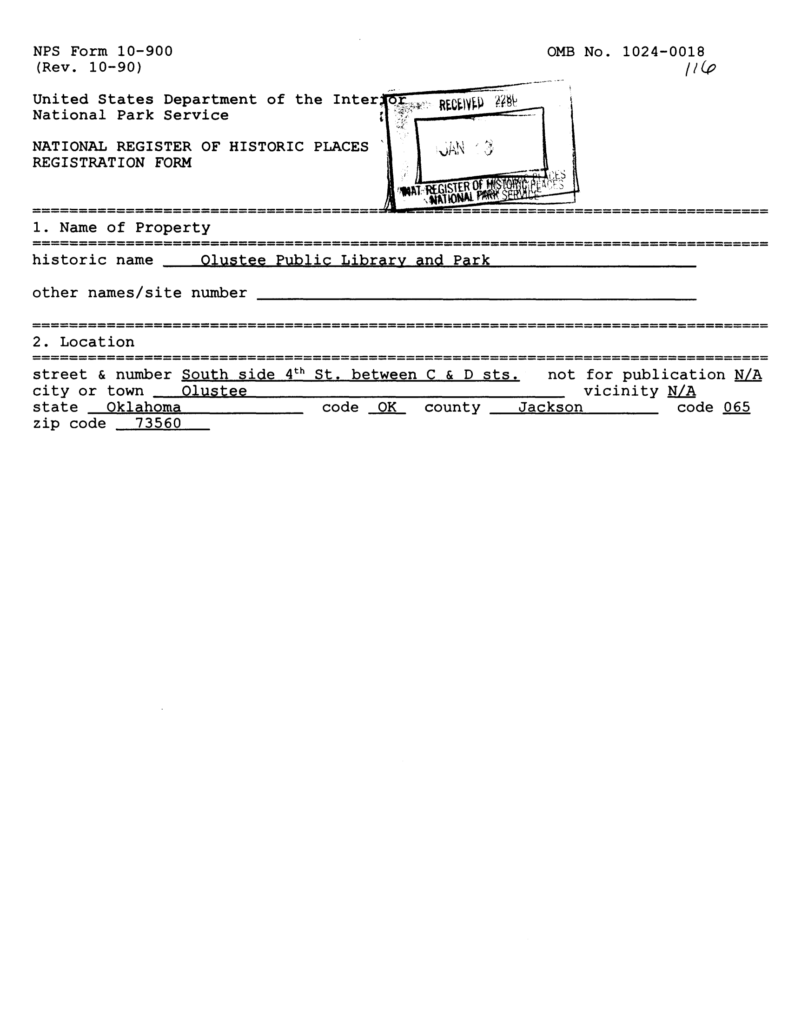
In the National Archives there is an enormous file on Olustee, Oklahoma’s application for its Library to be named as a National Register of Historic Places. https://catalog.archives.gov/id/86511214?objectPanel=extracted
This is an attempt to take only the interesting parts and present them in chronological order.
1895 The Olustee post office was established on 27 February 1895 at a point about three miles west of the existing town. The name of the town came from a battle in the Florida-Seminole War with Olustee being a Seminole word meaning pond. In 1895, the Olustee area was part of Old Greer County, a section of now-southwest Oklahoma which was claimed by Texas cattleman in 1880.
The federal government disputed this claim, maintaining Greer County was properly part of Indian Territory. Slowing but not halting development of the area, President Grover Cleveland issued a proclamation in 1884 warning people not to settle in the disputed county. Following the resolution of the controversy in favor of the U.S. government in 1896, Old Greer County was attached to Oklahoma Territory, formed from portions of Indian Territory in 1890. Long-time settlers in Old Greer County were allowed to file on 160 acres of occupied land and buy additional quarter sections at the price of one dollar per acre. In 1906, the Oklahoma Constitutional Convention divided Old Greer County into three whole counties, Jackson, Greer and Harmon, and a portion of another county, Beckham.
1901 Olustee owes much of its existence to the railroad. In 1901, C.G. Jones acquired the Northeast 1/4 of Section 20, Township 1 North, Range 21 West. He quickly platted this area into the new townsite of Olustee with the Oklahoma City and Southwestern Railway right-of-way extending diagonally through town. Jones, former mayor and noted entrepreneur of Oklahoma City, organized the Oklahoma City and Southwestern Railroad Company in 1900 with the purpose of connecting Oklahoma City to Quanah, Texas. This line extended southwest of Oklahoma City to Chickasha and Lawton before turning west towards Altus. At Altus, the line turned southwest again, to extend through Olustee and Eldorado. At the Oklahoma/Texas state line, the track took a south turn, ending in Quanah, Texas. Delayed until after the 1901 land opening of the Kiowa, Comanche and Apache lands to non-Native American settlement, the line was in operation between Oklahoma City and Lawton by August 1902. The track was completed into Quanah by mid-1903, critically providing Olustee with a major transportation means to larger markets primarily in Oklahoma but also with a Texas outlet. The Oklahoma City and Southwestern Railroad Company was subsequently acquired by the St. Louis and San Francisco Railway (Frisco) which eventually merged with the Burlington Northern Railroad Company. With trains bringing land seekers to the community, Olustee flourished.
1903, the town boasted two large stables, a wagon yard, three lumber yards, three physicians and a local newspaper.
1907 Olustee’s New State Women’s Club (NSC) was formed, the same year Oklahoma became a state, hence the name.
1907 In the spring of 1907, three female residents of Olustee began discussion of forming a club for the women of the burgeoning town. One of the three, Mrs. W. K. Barrett, belonged to a club in Oklahoma City and was very enthusiastic about organizing a club in Olustee. As a result, seventeen women gathered together on 20 April 1907 in the home of Mrs. Barrett and the New State Women’s Club (NSC) was organized. With membership limited to twenty-five, the motto of the new organization was Step by Step We Gain the Heights and the colors were heliotrope and white. One of the initial activities of the NSC was to establish a library. First located in the house of the NSC President Mrs. Tom Moore, the library moved to the home of Mrs. C.A. Copeland before moving up town where it remained in various commercial establishments, including Mr. Holts dry-goods store and the old Bank Building until the 1930s. At a subscription rate of $1.00 per member for decades. The rules of the library were quickly codified, including a fine of 25 cents for books kept longer than two weeks and 50 cents charged to any member lending a library book. Various club members served as librarians, opening the library for two hours one afternoon a week. By the 1920s, the library was open from 3 o’clock to 5 o’clock on Wednesday and Saturday afternoons.
1907 The town’s population reached over a thousand residents. At that time, Olustee had three churches, the Presbyterian, Methodist and Christian, with the Baptist congregation in the process of erecting a handsome new building. The school was a source of community pride as the best regulated public school in the new county. In addition to various other industries, the town claimed two gins, a sash and door factory, planing mill and a grain elevator and warehouse. The surrounding agricultural lands were also a prime attraction with abundant crops in cotton, corn, wheat, oats, broom corn, kaffir corn, milo, maize, alfalfa, fruit and garden truck of many varieties.
1916 In February 1916, the NSC announced that the Civic Committee had determined to secure a park for Olustee. The park was to include plenty of shade and comfortable seats, and swings for the children. The probability of attaining the goal was believed to be high as knowing the tenaciousness of the leader and her committee members it was felt the park could be had for very little expense and a small amount of labor.
Although the Civic Committee failed to land the city park, as planned in 1916, the committee remained undefeated by the much-dreaded enemy, lack of funds. While the park idea languished for several years, the members of the NSC turned their attention to other important matters.
1917 In 1917, following the entry of the United States into the Great War, the ladies of the club planned to lay aside usual programs and put in time doing and financing the Red Cross work. Two years later, continuing the democratic spirit diffused by our boys in the training camps club members sought to sponsor community singings at the high school auditorium. Additionally, in cooperation with the Mayor of Olustee, the club planned a town wide clean-up day with plans made to clean all the alleys with the trash placed in receptacles ready for the garbage man.
1920 The NSC again endeavored to create a community park in Olustee. The renewed interest in the park was likely influenced by the NSCs decision to initiate a Recreation Club for the young people of Olustee in January 1920. The purpose of this club was to promote and encourage sociability and wholesome amusements and outdoor recreation of various kinds. Later that year, the club voted to raise a fund in order to purchase land for a town park.
Approved at the 15 September 1920 meeting, a pro rata of $1.50 for each member present was to go the fund. By their next monthly executive meeting, the chairman of the Park Committee, Mrs. Moore, reported that lots for the park had been paid for and committee members, including Mmes. McCaleb, Truscot, Edwards, Crow and Lightner, were discussing setting out of trees. Less than a month later, the NSC changed the name of the Park Committee to Civic Committee in order to give the committee a larger scope of work for their supervision. Shortly after this, the Mayor of Olustee, encouraged by the NSC, called a mass meeting to bring the park matter to the attention of all the residents. At the town meeting, the proposition for the park was unanimously approved with E.G. Walcott, C.W. Edwards and G.A. Lightner appointed to obtain the remaining lots in the block south of the lumber yard or identify other locations for the park. Notably, both Edwards and Lightner had female relatives already serving on the NSC Civic Committee. Fundraising efforts for the park continued for several years.
1921 In January 1921, the NSC held a box supper to raise funds to purchase trees for the park. The fundraiser was deemed a success with $189.55 being raised.
1921 One of the most enduring amenities the NSC obtained for the park was the library building. As early as February 1921, the vision for the park included a library building. As described by Zala Drake in the local newspaper in 1921. After the trees and flowers are matured and the park made to look as if it were a park, a small stone building could be built in the center and used for a public library. Fifteen years later, this vision, including the location and building material, became a reality in the Olustee town park through the unprecedented assistance of the federal government during a time of dire economic distress at the local, state and national levels. Despite increasing signs of a major recession throughout the 1920s, the Great Depression of the 1930s manifested itself largely with the 1929 Wall Street stock market crash. This nationwide depression lasted for over ten years, resulted in prolonged massive unemployment and the worst depression in American history. Following the Wall Street collapse, the recession steadily grew for three years, culminating in 1932. While conditions did not improve after 1932, they ceased the marked downward spiral of the preceding years. The economic stimulus provided by President Franklin Roosevelt’s New Deal policies and wartime industries finally brought the country out of the depression by about the early 1940s. During the depression, both rural and urban areas suffered. Unemployment in urban areas created an unprecedented dependence on public welfare which city and state governments were unable to maintain. This inability to sustain urban families resulted in significant homelessness and malnutrition across the nation. Rural areas in the South and Midwest were doubly burdened, enduring not only economic hard times but also a decade-long drought. The Dust Bowl of the 1930s, comprising a line of states from the Dakotas to Texas including Oklahoma, devastated farming conditions. Due to declining domestic and foreign markets, overproduction of crops continued to lower farm good prices. In a nationwide trend, many farmers unable to make a living took to the road, searching for a more profitable future. As a predominantly agricultural state, the depression of the 1930s particularly devastated Oklahoma. During the three-year period of 1936 to 1938, 500 to 600 hours each year of sun-obscuring dust ravaged the southern plains state. By 1939, due to drought conditions and erosion, it was estimated that twenty-five percent of Oklahoma’s soil was lost to production. Furthering Oklahoma’s agriculture crisis were the large number of tenant farmers in the state. In1930, sixty-two percent of Oklahoma farmers were tenant farmers, representing the highest rate of tenancy in the Midwest. With no tangible ties to the land, tenant farmers were essentially a dispossessed people searching for sufficient economic means to subsist. Thus, they moved frequently and often lived below poverty standards. Their plight was compounded during the depression years by the drought conditions which reduced farm incomes even further, leaving them with little choice but to resort to the relief system or migration out of Oklahoma. Agriculture, however, was not the only industry in the state greatly impacted by the depression. The oil market, another major economic force in Oklahoma, collapsed as factories and mines shut down. The price of oil fell from a $1.30 a barrel in 1930 to about a $.01 per barrel in 1932. This resulted in the closing of wells at an unprecedented rate, 21,603 wells in 1931 alone.
Statewide, oil and natural gas production fell by about thirty percent, a significant economic drop. Unemployment in the State was at an all-time high. By May 1936, 242,000 workers statewide were without jobs. Due to the inclement economic conditions, migration out of Oklahoma became so intense the term Okie became a popular name for the dispossessed workers searching for work in other states, particularly California. With local and state relief agencies increasingly strained beyond capability, the majority of counties in Oklahoma and nationwide were in need of some type of federal relief to alleviate chronic unemployment and its results.
1922 In January, the NSC sponsored a picture show at the Victory Playhouse which raised just over $30 for the park fund.
1922 The NSC continued to actively promote and aid in the development of the park. On 11 November 1922, the NSC held a memorial program at the park with memorial trees being planted in the park for twelve local boys.
1923 By 1923, the town of Olustee owned all but one lot in the park block
1925 This lot was acquired in 1925 through a tax sale.
1925 In September 1925, club members promised to pay twenty-five cents each time their trees were watered. Four years later, the club was given $9.73 by the local Chamber of Commerce to pay for much-needed sprinklers in the park.
1936 The public library building was erected in the park in 1936 as a project of the Works Progress Administration (WPA). Like the park, the library building project was initiated by Olustee’s New State Club (NSC) with the club soliciting the WPA to construct the building and operating the library until its closure in the 1990s. The NSC also provided the books in the library with members serving as librarians until the 1990s. The town continues to maintain the building, leaving the contents virtually untouched.
1936 Both area newspapers reported that the federal allotment for the project was $3,089 with the town’s share of the project costs unknown. By the end of May 1936, work on the native stone library building was progressing nicely with twenty-three men being employed on the project. With the town council’s contribution of $582.82 towards the project, the total cost of the library building was expected to be $3,671.82. The public library and park improvement project was only one of several WPA projects in Olustee and Jackson County. At that time, thirty-three men were employed on a project sponsored by the Olustee school district to repair school buildings. The federal share of this project amounted to $4,530 with the school districts portion coming in at $1,733. Additionally, near Olustee, emergency bridge repairs cost the federal government $2,133.04 and the county government $758.
Overall, in just a year into the WPA program, the federal government had expended $247,948.71 in Jackson County with project sponsors spending an additional $107,055.10 on various projects countywide. Combined, the projects provided employment to 621 Jackson County residents. This was the highest portion of relief expended in the WPAs Oklahoma District A, consisting of Jackson, Beckham, Custer, Dewey, Greer, Harmon, Kiowa, Roger Mills, Tillman and Washita counties.
The Olustee Public Library building was completed by mid-August 1936. Shortly before this, the NSC held an emergency meeting to discuss the matter of finishing the interior of the library building. Club members quickly made and approved a motion to pay a bill of $8.08 for wiring in the building. Additionally, the club agreed to use their money for finishing the interior of the building with the executive committee attending to the details. Finishing details apparently included purchasing material for curtains, curtain rods, light bulbs, fuses, paint, six chairs, a bookshelf and an oil mop. In addition to providing money for completing the building, the NSC also donated their library of 2,000 books and bookcases to the new town library. The club, at the request of the town council, also was placed in charge of the now-free community library. In preparation of the new library, the club also used the assistance of six girls employed by the National Youth Administration (NYA). Aimed at providing aid to young people, the NYA operated under the auspices of the WPA to provide employment to jobless youth, as well as set up technical training programs. In July 1936, a total of 47 Jackson County youth were employed by the NYA. Besides aiding the NSC in book repairs and move preparations at Olustee, Jackson County NYA workers were employed at city halls, chamber of commerce offices, hospitals, schools and parks. The youth were paid thirty cents an hour with a maximum of thirty hours every month. Following the opening of the library building in August 1936, the NSC continued to operate the library through the early 1990s when the club disbanded. By the early 1960s, the number of books in the library reached 4, 600, more than doubling the number of books originally donated by the NSC. Throughout these years, the club maintained remarkable library records which presently remain in the closed library building. The club also maintained its involvement in the park, providing flower beds in the late 1930s and seemingly continuously planting trees in the park.
The Olustee Public Library and Park are nominated to the National Register for their association with the NSC. Although the library is an excellent example of the economic relief provided by the WPA and clearly an architectural gem of a building, the significance of the NSC’s contribution to the betterment of life quality in Olustee through the development of the park, construction of the library building and operation of the Olustee Public Library is paramount. By sponsoring the continued improvement of the park and library, the NSC provided the Olustee community with facilities they likely would not have had otherwise. The WPA required that their projects be a “permanent and useful addition to the community.” Although not put in those terms, this was exactly the result of the NSC’s efforts on these two projects. The club also expended much time and energy on other worthwhile projects which directly and indirectly improved the community, state and nation. Overall, the tangible efforts of the NSC to promote the welfare of society in the form of the library building and park are eminently worth of recognition for their historic significance to the community of Olustee.
The Olustee Public Library and Park are eligible for the National Register of Historic Places. The Olustee Public Library and Park are nominated to the National Register for their association with the NSC. Although the library is an excellent example of the economic relief provided by the WPA and clearly an architectural gem of a building, the significance of the NSC’s contribution to the betterment of life quality in Olustee through the development of the park, construction of the library building and operation of the Olustee Public Library, is paramount. By sponsoring the continued improvement of the park and library, the NSC provided the Olustee community with facilities they likely would not have had otherwise. The WPA required that their projects be a “permanent and useful addition to the community.” Although not put in those terms, this was exactly the result of the NSC’s efforts on these two projects. The club also expended much time and energy on other worthwhile projects which directly and indirectly improved the community, state and nation. Overall, the tangible efforts of the NSC to promote the welfare of society in the form of the library building and park are eminently worth of recognition for their historic significance to the community of Olustee.
1939. The bills were structured to sustain various parts of the economy. The majority of acts sought to provide some type of relief for the unemployed. The Works Progress Administration (WPA) originated in May 1935 when the Emergency Relief Appropriation Act of 1935 replaced the 1933 Federal Emergency Relief Act. Believing that work rather than direct relief should be the keystone of Federal policy with respect to needy employables, the 1935 act authorized a new program of federal relief employment, building upon earlier New Deal programs such as the Civil Works Authority.
In regard to the club library project. Within days, Mrs. Smith received a long distance telephone call which informed her that State W.P.A. headquarters had allocated the sum of $3089 for the Building of the Olustee Public Library. The Olustee Public Library project proceeded quickly. Just weeks after the project was approved, O.B. Fultz of Mangum was appointed the project superintendent. In mid-April 1936, nineteen men from Olustee were already hard at work quarrying stone for the library from the Jim Long place, a site west of Olustee. The newspaper also noted that Olustee men only are to be employed in the construction of the building, unless special labor is required. Interestingly, the total cost of the project had not been determined at that time. The Olustee Public Library building was completed by mid-August 1936. Shortly before this, the NSC held an emergency meeting to discuss the matter of finishing the interior of the library building. Club members quickly made and approved a motion to pay a bill of $8.08 for wiring in the building. Additionally, the club agreed to use their money for finishing the interior of the building with the executive committee attending to the details. Finishing details apparently included purchasing material for curtains, curtain rods, light bulbs, fuses, paint, six chairs, a bookshelf and an oil mop. In addition to providing money for completing the building, the NSC also donated their library of 2,000 books and bookcases to the new town library. The club, at the request of the town council, also was placed in charge of the now-free community library. In preparation of the new library, the club also used the assistance of six girls employed by the National Youth Administration (NYA). Aimed at providing aid to young people, the NYA operated under the auspices of the WPA to provide employment to jobless youth, as well as setting up technical training programs. In July 1936, a total of 47 Jackson County youth were employed by the NYA. Besides aiding the NSC in book repairs and move preparations at Olustee, Jackson County NYA workers were employed at city halls, chamber of commerce offices, hospitals, schools and parks. The youth were paid thirty cents an hour with a maximum of thirty hours every month.
Following the opening of the library building in August 1936, the NSC continued to operate the library through the early 1990s when the club disbanded. By the early 1960s, the number of books in the library reached 4, 600, more than doubling the number of books originally donated by the NSC. Throughout these years, the club maintained remarkable library records which presently remain in the closed library building. The club also maintained its involvement in the park, providing flower beds in the late 1930s and seemingly continuously planting trees in the park.
2006 Olustee Park & Library placed on National Register of Historic Places and metal plaque placed on Library Building.

See National Register of Historic Places registration form,