My First Wife Dorothy Ho
 My first wife was a Chinese named Dorothy Ho. She was born in Kuala Lumpur, Malaya. In the picture to the left (taken about 1960), Her Mother, Theresa (Chin) Ho, is in the middle, surrounded by her daughters from left to right: Ruth, Annette (adopted), Dorothy and Gladys.
Family lore is that Dorothy’s grandmother on her mother’s side married, in Malaya, a Portuguese by the name of Xavier – first name unknown. This may account for the fact that many of her family were taller and with fairer skin than most Chinese.
Her father, Ho Kim Hoi, had become a Roman Catholic to marry Theresa – a devout Catholic. They had seven children, before he, following a Chinese tradition, took on a concubine. Mrs. Ho would no longer live with him. This is an example where western ways and eastern ways clashed. Mr. Ho and his concubine, whose name I have forgotten, moved to Bangkok, Thailand, although he still supported his family in Kuala Lumpur. I met her one time, and she was delightful.
My knowledge of Dorothy’s life is not complete. She died of cancer fourteen months after our marriage, so the facts below are rather sparse.
I do know that her early life was very happy until her father left. All her education before the war was in Bukit Nanas Convent School run by the Sacré-Coeur nuns.
While she was in school, all hell broke loose!
On December 8, 1941, the Japanese invaded Malaya, which was at the time a British Colony. The British were not prepared and after a matter of five weeks, the Malay Peninsula including Singapore, had fallen to the Japanese.
Dorothy, still a young girl, happened to be visiting relatives in Singapore and could not get home. To keep her from harm from the Japanese soldiers, her uncle managed to get her on board a ship. The destination of the ship was unknown, and it depended on what troubles it encountered in the harbor. She had no “papers” of any kind. She had never seen a passport. The ship ended up in Bombay, India (now Mumbai). Frightened out of her wits, she didn’t know what to do. The Roman Catholic Church came to her rescue. It arranged with the Sacré-Coeur nuns to take her into their school. She was a girl with only a tiny suitcase (which she kept throughout her life), a girl with no money, without a country and with no family. Her hatred of Japan and any thing Japanese began and was only to intensify later.
She was unwilling to talk much about it, but it can be assumed that she did well because, the nuns, toward the end of the war, were able to get her a four-year scholarship, complete with room and board, and free transportation to a Catholic college in Ohio. She was there when the war ended, and she was able to reconnect with her family for the first time and hear about the terrible things that had happened to them. She had been the lucky one.
While there are many wonderful Japanese individuals, collectively as a war machine, they became less than animals. The word “cruel” does not begin to tell how awful they were to the local populations all over Southeast Asia. And the Japanese were even worse to their prisoners.
Her father with the concubine seems to have flourished in Bangkok, Thailand, which had officially remained neutral, but had been unable to get money to Mrs. Ho in Kuala Lumpur. Dorothy never knew in detail and was very reluctant to talk about how Mrs. Ho was able provide for four children during the four long years – all that she had left of her seven.
She had no idea until after the war whether Dorothy was alive or dead.
A son, Lawrence, had been sent as a prisoner to labor on the Burma-Chinese railroad and was never heard of again. The movie, Bridge on the River Kwai, with its depiction of unbelievable torture, was sugar-coated compared to the facts.
Mrs. Ho’s sister, Rose, whose only crime was to have a western name (she had married and divorced an Australian) was in Changi prison camp in Singapore for four years. Rose was a strong and proud lady, who early in her imprisonment, refused to kowtow (bow) to the Japanese every time they were encountered. This was required. She survived, probably because a friend advised her, upon meeting a Japanese in the camp, to look at her feet. This Rose would do.
On a happier note, Dorothy’s father was able to pay her sister, Ruth, to join her at the same college where they both graduated, after which Ruth returned to Malaya and became the chief nutrition officer for Malaya.
Before returning to Malaya for a visit, Dorothy, on full scholarships, earned two master’s degrees from the Catholic University of America. One was in English (1950) and the other was in Library Science (about 1952). She then got a job at the Library of Congress in the Music Cataloging Section.
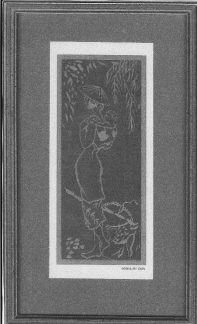 In 1963, at the age of 32, I joined the Peace Corps which proved to be a major life-changing experience. I was assigned to Malaya (later Malaysia) in Kuala Lumpur. My assignment was to be a librarian at the University of Malaya half-time and a lecturer in music at Maktab Perguruan Bahasa (Malayan Teachers’ College), also half-time. In addition to two half-time positions, I also conducted a Boy Scout choir, and, more appropriate to this story, directed a choir at the Bukit Nanas Convent Secondary School, where I later learned Dorothy had attended. To get there I had to walk up a sizeable hill in the tropical sun with 92-degree temperature and 98% humidity. I always arrived soaked to the skin. One day a lady picked me up and drove me up the hill. Her name was Ruth Ho. The reader will notice that this is the Ruth, Dorothy’s sister, who attended college with her in Ohio. No, I did not know Dorothy at this time. Another coincidence was that one of my students was an artist by the name of Rosemary Chin. Rosemary once invited me to celebrate Chinese New Year with her family. I was unable to accept this invitation. The following Christmas, I received a Christmas card from Rosemary depicting a drawing she had done of a Malaysian mother and child. After Dorothy and I married, she found this card in my belongings and asked me where I got it. After I told her about it, she told me that Rosemary was her cousin. Had I gone to her family’s Chinese New Year party, I would have met all of Dorothy’s family!
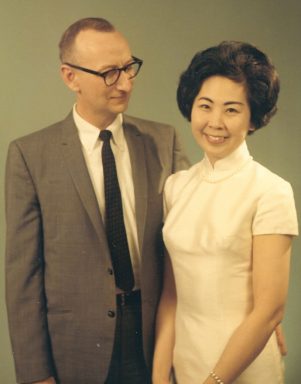
The staff at the University Library in Kuala Lumpur were very proud to tell me about a Malaysian woman who worked at the Library of Congress but didn’t know her name.
After Peace Corps, and upon return to the States, I spend two years at Washington University in St. Louis before being hired, in 1967, by the Library of Congress as the Assistant Chief of the Descriptive Cataloging Division. Somehow, I remembered that a Malaysian was at the Library of Congress. After making some inquiries, found that there indeed was a Malaysian named Dorothy Ho at the Library – and that she worked for me! My whole life has been filled with incredible coincidences. This was another.
I met her and her sister Ruth who was in the States on a visit and found that Dorothy was being promoted to the head of the French Section in another division. This meant that soon she would not be working for me, making it possible for us to date.
The many languages she learned during these early years were: English, the language spoken in the home; Hokkien, which she learned from the amah (servant), spoken Cantonese, and French – which she learned at school. She could not read or write Cantonese. (In Chinese restaurants, she would ask for the Chinese menu, pretended to read it, talk it over with the waiters in Chinese (she knew several dialects), and order. We ate wonderfully. She also had a photographic memory.
I was 36 years old, and I had finally found someone that I wanted to marry. Since she was Catholic and we were to be married in the Church, I had to undergo an interview with the Priest, her friend, who had helped her with all her immigration issues. We took him to dinner, and I don’t recall any questions for which I didn’t have answers, such as belief in Trinity, etc. After a whirlwind courtship we were married in December 1967.
The next year was a busy year. We were both adjusting to new jobs. I don’t recall any extraordinary thing happening in our happy marriage before she died from cancer fourteen months later. In December of 1968 we both caught the flu. I got well but Dorothy could not shake it. Her breast cancer had reoccurred, spread to the liver, went to the brain. She died two and a half months later.
It is hard to explain how hurt I was and how destitute I felt. I recall saying to myself that I would never marry again because I couldn’t bear being hurt again. I didn’t like being around others and I didn’t like being by myself. I had no place to “be.” The only release I had was playing the piano, hour after hour. It served as an escape but did not heal. In order to function in my job, I built a façade of normalcy above me, but I was living a lie.
I suppose I was like this for about a year when I finally said to myself “I don’t like you anymore.” This seemed to start my apotheosis. Gradually I began to improve. Friends who had tried to help were still there. For a while I practiced Transcendental Meditation which forced me to sit quietly for twenty minutes twice a day, clearing my mind. It calmed me down. I stopped feeling sorry for myself and began to enter again the social whirl of parties – and yes, dating, knowing all the while, in order not to be hurt, I would never remarry.
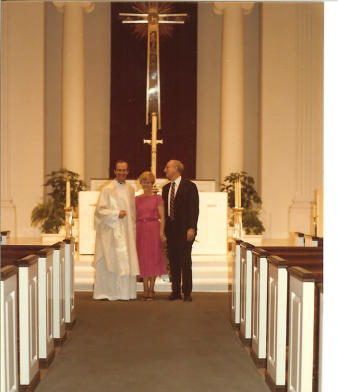 Well, eleven years later, I met my current wife, Patricia, whose husband Joseph Schiebel, had died a couple of years earlier. We were introduced by my cousin, Suzan (Howard) Rosenthal, who was Pat’s best friend from Seattle days. When I found the right one, that nonsense about remarrying went out the window. In 1980, I married again. She was also Catholic, and I had to undergo another round of being approved. This time it was by Father English, who was Pat’s friend as well as a friend of her hate husband. I was nervous about being asked theological questions which I wasn’t such that I could answer in the approved way. It turned out that it was also a simple interview and the only question that I recall was whether I would welcome children. It was easy to say “yes” since I had had a vasectomy.
Nineteen years later, I can still say that Pat is the most wonderful thing that ever happened to me. Only please God, I want to die first.
